CEMI Labs · with IBizAI

Financial
Innovation Lab

Where financial technology stops being a slide and starts being a machine. Four experimental areas for testing the future of money — real hardware, a simulated financial ecosystem, open sandboxes and real people. Real tools and platforms, real conditions.

5+advanced ATM/ITM machines on the floor
9working areas
5programs, classroom to deployment
40+AI agents, tools & frameworks in the Sandbox
5+live prototypes & programs you can visit

Where opportunities become pilots

This is where ideas and new technologies stop being opportunities and challenges — and become ready-to-market pilots, tested on real-life devices in controlled environments — accelerating innovation across the financial sector.

Ideas become projects: connected with partners, mentors and experts; tested across multiple scenarios; submitted to stress and security tests. And validated by users, vendors and providers on real platforms, devices and sandboxes — ATM, ITM, smartphones, cameras, wireless readers, APIs, web services and more.

Three minutes on the floor

Watch what the Lab is — narrated, in motion: the four experimental areas, the Virtual Financial Ecosystem, and the programs, in under three minutes.

The Experimental Areas — Intelligent Machines / The Virtual Financial Ecosystem / The Open Sandbox / The Living Lab

The Lab runs on four experimental areas — interconnected, integrated, and at the service of the industry, stakeholders, partners and academia. Hardware experiments lean on the software rails, software experiments prove themselves on physical machines, and both are exercised against a simulated financial ecosystem — before all of it is validated where it finally matters: with people.

Intelligent Machines — the physical lab

The latest generation of ATM/ITM and self-service hardware, enabled and enhanced with artificial intelligence — real machines on a real floor. This is where our flagship Intelligent ATM Program operates.

Top-of-the-line ATM and ITM machines, wired for experimentation rather than production duty. They run face recognition, accept touchless cards, host interactive experiences, complete digital onboarding and close online purchases — and every interaction can be observed, measured and improved.

  • Biometric flows tested on public-terminal hardware, not laptop webcams
  • Contactless and card-present payment paths, end to end
  • Onboarding a first-time user at a machine — the hardest UX in finance
  • Purchases that begin online and finish at a terminal, or the reverse
The Financial Innovation Lab floor: five advanced ATM and ITM machines under the CEMI Financial Innovation Lab sign, with technicians working behind them
The floor: ATM/ITM stations under the Lab sign, technicians at the benches behind.

The Virtual Financial Ecosystem — a digital twin of the financial ecosystem

Simulated banks, the Central Bank’s rails — the LBTR and the instant-payments system SGPI — card networks and acquirers, electronic-payment entities, credit bureaus, identity, regulators and the financial-intelligence unit. All of them speak real formats, keep real state and obey the Reglamento de Sistemas de Pago, so an application runs a whole process end to end without touching a single real institution.

One synthetic population moves through every counterpart, so a process that crosses six organizations is exercised as one process, under the rules that will apply when it is real: onboarding to settlement, a card cycle, a suspicious-transaction report. No real people, no real money — and an instrumented report at the end.

  • Central Bank
  • LBTR
  • SGPI · instant payments
  • Banks
  • Electronic-payment entities
  • Acquirers & sub-acquirers
  • Card networks
  • Credit bureaus
  • Identity
  • Regulators
  • Financial-intelligence unit

Ready for 2027, today.

A digital twin of a financial ecosystem: translucent glass blocks standing for banks, networks and regulators, arranged around a taller central tower and wired together by luminous gold filaments on a dark grid

The Open Sandbox — the software environment

Cloud and on-premise sandboxes of platforms, APIs, frameworks, web services, integrations and Anti-Money-Laundering compliance systems — plus agents, skills, plugins, data connectors, wrappers and enterprise capabilities — where products and solutions are tested, interconnected, integrated and showcased before anyone signs anything.

Live in the Sandbox today: Financial Services AI Toolkit — 40+ agents, skills, plugins, connectors and integrations · CEMI Cumplimiento — AML compliance platform (PLAFT/PADM)

The Lab is the integration of four experimental areas; two of them are software: the simulated ecosystem, and these open sandboxes — APIs, frameworks, web services, integrations — where products and solutions are tested, interconnected, integrated and showcased — identity, payments, blockchain, AI services and data flows exercised against each other before anyone signs anything.

Test

Your product against realistic rails, data and adversaries.

Interconnect

Your APIs against other participants’ systems — the integration is the experiment.

Integrate

Into full journeys that end on the physical floor.

Showcase

To partners, sponsors and customers, on real machines instead of screenshots.

Isometric illustration of interconnected software sandboxes: translucent modules linked by golden data streams around a central ATM terminal

The Living Lab — the human experimental area

People are the fourth experimental area. The Living Lab is where technology meets its users under real conditions — social inclusion, capacity building, educational programs and user engagement. Three programs run here today; the floor is laid for customer-experience testing, user awareness and onboarding research.

Financial Health (Salud Financiera) · Finance for Women (Finanzas para Mujeres) · Financial Calculators

Nine working areas

Phygital experiences

Interactive systems on real ATM/ITM hardware — one continuous experience across the screen in your hand and the machine on the street.

Digital onboarding & identity

Face recognition, document capture and identity management tested where they are hardest: on a public terminal, with a first-time user.

Secure payments

Touchless cards, tokenization and blockchain settlement — exercised end to end on machines built to be attacked.

Financial inclusion

The bridge between banked and unbanked: assisted flows, low-literacy interfaces, cash-in/cash-out for people the system was not designed for.

Advisors, calculators & wizards

Financial guidance that meets people mid-transaction — on the terminal, in the browser, in the branch.

AI agents & agent swarms

Models, frameworks and multi-agent systems doing real financial work — and being measured while they do it.

Interconnection of systems & data

The unglamorous problem that decides everything else: making core systems, rails and data actually talk to each other.

Cybersecurity

Adversarial testing on the same floor where features are born — because a demo that has never been attacked is not a result.

Data protection

Personal and organizational data handled as a design constraint from the first sketch, not a compliance patch at the end.

Five programs, one floor

From a sketch to a deployment-grade pilot — and from a classroom to the floor — each door has a program, and each program ends with something you can show. Once a year, the whole floor becomes a racetrack.

Early Exploration

For ideas that deserve more than a document.

Turn a concept into a test pilot quickly: sketch the flow, mock what must be mocked, and put it on lab hardware in front of people. Learn whether the idea breathes before anyone builds it properly.

  • Fast concept-to-pilot cycles on real machines
  • Lab guidance on what to fake and what to build
  • A clear go / pivot / stop signal at the end

Rapid Prototyping

For solutions that already work — somewhere safe.

Your product runs under real-life conditions: real machines, real integrations, unscripted users. The Lab instruments the whole run and hands you what a staging environment never can — evidence.

  • Structured pilots on the ATM/ITM floor and in the sandboxes
  • Security and data-protection review as part of the run
  • A findings report you can put in front of a board or a regulator

FinLab Fellows

For business and academic researchers.

A residency with access to the floor, the sandboxes and anonymized interaction data. Study how people actually use financial technology — and publish. The Lab gets better questions; the field gets real answers.

  • Research residencies for academia and industry
  • Access to machines, sandboxes and observational data
  • Publication encouraged — findings belong to the field

Internships

For undergraduate and technical-career students.

The Lab opens its floor to students on two paths: bring a project of your own and build it on technologies, software and devices no classroom has — or step into a live Lab project with real tasks, real roles and real responsibility. Either way, the practical hours your academic program requires get earned on working machines, not simulated ones.

  • Your own project, on real equipment
  • Assigned roles inside live Lab projects
  • Practical hours certified for your academic program

The Annual Championship

For teams of students, professionals and organizations.

Once a year, the Lab sets a financial-innovation challenge and teams race it — closer to Formula 1 than to a hackathon. Each team is paired with or sponsored by a fintech startup, a financial institution or another organization, and builds toward a real, viable solution on the Lab’s machines and sandboxes.

  • Teams backed by real sponsors, racing a real challenge
  • Not a make-a-thon: nobody leaves with just a slide deck
  • Every team crosses the line with a ready-to-market program, pilot or plan — everyone wins, including those who don’t

FinLab Fellows — the residency programme

Programme 03 has a page of its own. A Fellow is a resident: someone who arrives with a defined question, works it on the experimental areas under supervision, on a real problem — and leaves findings that publish. The tracks, what Fellows get, what the Lab asks, how cohorts form and the application form all live there.

  • Research residency
  • Engineering fellowship
  • Regtech and compliance
  • Design and phygital experiences
  • Inclusion and the Living Lab

Join the Financial Innovation Lab — work with us

Partners

Bring your technology to the floor. Hardware, identity, payments, AI, security — integrate with the rest of the stack and be part of every pilot that touches your layer.

Sponsors

Back a bench, a zone or a named challenge. Your brand stands where the industry comes to test — and the results carry your name with them.

Customers

Banks, cooperatives, fintechs and retailers: commission private pilots, pre-deployment testing and proof-of-concept runs, with the Lab’s machines and instrumentation at your service.

Stakeholders

A door of its own for those the system must serve: small startups — fintechs, insurtechs, regtechs — testing technology they could never afford a floor for; and social and civic associations bringing consumer rights, privacy, accessibility and inclusion into the room where the technology is decided.

Existing and running programs

The Lab is not a promise — 5+ live prototypes and programs are open to visit right now. The Intelligent ATM on the machines; the Virtual Financial Ecosystem Simulation; the Financial Services AI Toolkit and the AML compliance platform in the Open Sandbox; and three programs with real people in the Living Lab.

Intelligent ATM Program

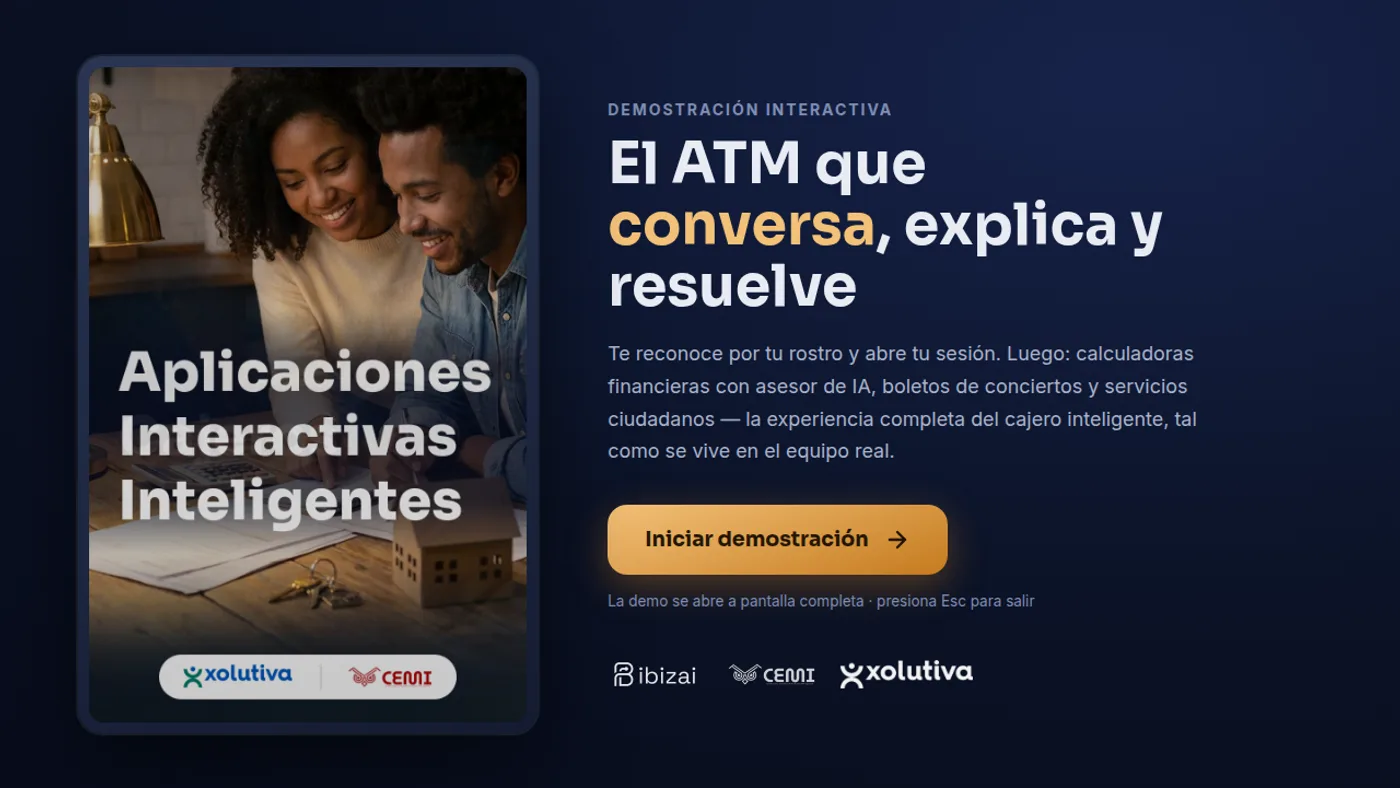
The flagship: interactive applications, e-commerce, onboarding and account opening, card issuance and AI on real machines — live demo above.

See the showcase ↑

Virtual Financial Ecosystem Simulation

A simulation of the Dominican financial ecosystem — banks, the Central Bank’s LBTR and SGPI rails, card networks and acquirers, electronic-payment entities, bureaus, identity, regulators and the financial-intelligence unit, all speaking real formats with the Reglamento as executable rules. Ready for 2027, today.

In the Lab → · financialecosystem.io →

Financial Services AI Toolkit

40+ agents, skills, plugins, data connectors, wrappers, integrations and enterprise capabilities for financial services — the Open Sandbox’s first live offering.

ibizai.ai/en/services/claude-for-financial-services →

AML Compliance Platform

CEMI Cumplimiento: Anti-Money-Laundering compliance tools (PLAFT/PADM) — live in the Open Sandbox alongside the AI Toolkit, operating today.

compliance.ibizai.ai →

Financial Health (Salud Financiera)

A financial-health learning experience on aiLearning’s Smoother platform — personal finance taught as capability, not lecture.

experiences.ailearning.global →

Finance for Women (Finanzas para Mujeres)

A learning series on finance for women — financial inclusion as a program people actually complete, not a slogan.

experiences.ailearning.global →

Financial Calculators

Twelve free calculators — mortgages, loans, savings, retirement, business planning — running entirely in the browser, explained in plain language.

ibizai.ai →

Questions, answered

What exactly is the Financial Innovation Lab?

Four experimental areas, operated by CEMI with its IBizAI initiative. Intelligent Machines — the latest ATM/ITM and self-service hardware, enabled and enhanced with artificial intelligence, wired for experimentation. The Virtual Financial Ecosystem — a digital twin of the country’s banks, rails, networks and regulators, so a whole process can run end to end without touching a real institution. The Open Sandbox — where products connect, integrate and are showcased. And the Living Lab — where all of it meets real people. Technology gets tested on real machines, against a real-format ecosystem, with real people, under real conditions.

What can I actually test on the machines?

Face recognition, touchless cards, digital onboarding, interactive on-screen experiences, online-purchase flows that finish at a physical terminal, and the security around all of it. If your product touches the moment where money meets a machine, it can probably be tested here.

Who is the Lab for?

Banks, cooperatives, fintechs and retailers testing before deployment; researchers from business and academia studying how people really interact with financial technology; and builders with an idea that deserves a pilot rather than a slide.

Which program is for me?

Early Exploration turns an idea into a test pilot quickly, prototyping directly on lab hardware. Rapid Prototyping takes a solution that already works and runs it under real-life conditions on real machines, ending in a findings report. FinLab Fellows hosts business and academic researchers for deeper, longer questions. And Internships bring in undergraduate and technical-career students — on their own projects with real equipment, or in assigned roles inside Lab projects, earning the practical hours their academic programs require. And once a year, the Annual Championship pits sponsored teams of students, professionals and organizations against a financial-innovation challenge — every team finishing with a ready-to-market program, pilot or plan.

Is there a demo I can try right now?

Yes — the interactive ATM experience is public at ibizai.ai/atm/launch. It shows the bridge the Lab is built around: physical and digital, online and in-person, banked and unbanked, as one continuous flow. In the Open Sandbox, the Financial Services AI Toolkit — 40+ agents, skills, plugins, data connectors, wrappers, integrations and enterprise capabilities for financial services — and the CEMI Cumplimiento AML platform are both live today.

How do partners and sponsors take part?

Partners bring technology to the floor and integrate it with the rest of the stack. Sponsors back a bench, a zone or a named challenge. Customers commission private pilots and pre-deployment testing. The form below reaches the team for all three.

Do you handle real customer data?

The Lab runs on test data and consenting participants. Data protection is one of the working areas — treated as something to design and test for, not a disclaimer.

What is the Virtual Financial Ecosystem?

A digital twin of the financial ecosystem: simulated banks, the Central Bank’s LBTR and the SGPI instant-payments system, card networks and acquirers, electronic-payment entities, bureaus, identity, regulators and the financial-intelligence unit — all speaking real formats, keeping state and obeying the Reglamento de Sistemas de Pago. A team plugs its application in and runs onboarding, transfers, cards, compliance and settlement end to end, with no real people and no real money, and gets an instrumented report. It is not a substitute for any regulator’s authorization, and no simulator presents itself as the real institution. Ready for 2027, today.

Where do I start?

Send the form below with the track that fits you, or write to us on WhatsApp at +1 (849) 265-2665. If you are near the Lab, ask for a floor visit — the machines make a better argument than any deck.

Contact us. Work the floor. Raise the bar.

Tell us which door you are knocking on — the team answers all of them.